

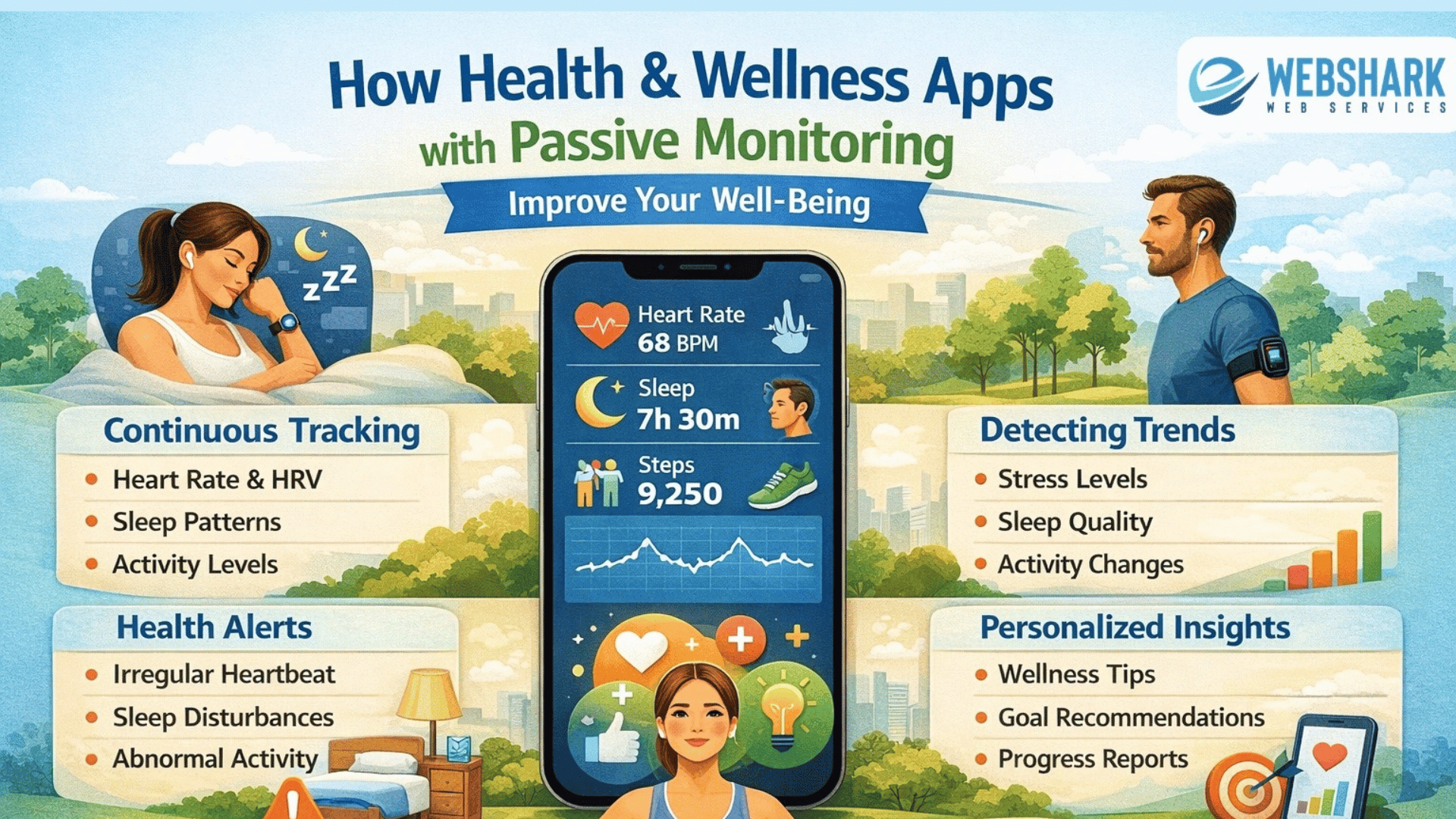

There’s something different about waking up and realizing an app on your phone noticed you didn’t sleep well — before you even had your morning chai. No alarm, no reminder, no push notification asking you to log your mood. It just knew. That’s the quiet power of passive monitoring, and it’s slowly becoming one of the most meaningful shifts in how Indians think about their health.
We’re not talking about fitness trackers that shame you for skipping a workout. We’re talking about a new generation of health & wellness apps that work in the background — collecting signals, identifying patterns, and nudging you gently when something seems off. And in a country where over 197 million people experience some form of mental health challenge (according to a 2023 Lancet study), the timing couldn’t be more relevant.
What Is Passive Monitoring, Anyway?
Before we go further, let’s clear up what “passive monitoring” actually means in the context of a health & wellness app.
Active monitoring is what most of us are used to — you open an app, log your water intake, tap your mood, or manually start a workout session. Passive monitoring flips this entirely. The app runs quietly in the background, using your phone’s sensors, GPS, microphone patterns, screen time data, accelerometer, and even typing rhythm to build a picture of your mental and physical state — without you lifting a finger.
The result? A more honest, consistent dataset. Because let’s face it: most of us forget to log things, or we log them inaccurately. Passive data doesn’t lie the way self-reported data sometimes does.
For users in India — where people juggle long commutes, family pressure, work stress, and inconsistent sleep schedules — this kind of always-on health intelligence is more than a convenience. It’s genuinely useful.
Why India Is Ready for This Shift ?
India’s relationship with mental and physical wellness has changed dramatically over the last decade. The stigma around seeking help still exists, but it’s eroding — especially among millennials and Gen Z in Tier 1 and Tier 2 cities. More importantly, smartphone penetration has reached a point where digital health tools are accessible to a far wider population than ever before.
The numbers tell the story. India had over 750 million smartphone users as of 2024, with affordable data plans making it one of the highest mobile internet-consuming nations globally. This creates fertile ground for health & wellness apps with passive monitoring in India to grow from niche tools to mainstream necessities.
Add to this the post-pandemic mental health awakening — where burnout, anxiety, and loneliness became mainstream conversations rather than whispered admissions — and you have a population actively looking for solutions that are private, affordable, and non-intrusive.
The Rise of Evidence-Based Mental Health Apps
Here’s where things get interesting — and where the industry often goes wrong.
Not every wellness app deserves your trust. The market is flooded with apps that offer “mood boosts” through random quotes or breathing exercises with zero clinical backing. That’s not good enough anymore. Users are smarter, and so are the standards they should hold these apps to.
Evidence-based mental health apps are built differently. They’re developed with input from clinical psychologists, psychiatrists, and behavioral scientists. Their features are grounded in established therapeutic frameworks like Cognitive Behavioral Therapy (CBT), Dialectical Behavior Therapy (DBT), and mindfulness-based stress reduction (MBSR). And critically, their effectiveness is tested through peer-reviewed research before being pushed to millions of users.
In India, a handful of platforms are starting to take this approach seriously. Apps like iCall, Wysa, and YourDOST have incorporated clinically validated methodologies into their design. Wysa, for instance, uses AI conversation tools grounded in CBT principles, and has published research showing measurable improvements in user anxiety and depression scores. That’s not just marketing — that’s accountability.
When Webshark evaluates health apps for clients and partners, one of the first questions we ask is: Where’s the evidence? Because a beautiful interface and a calming color palette don’t make an app therapeutic — the science behind it does.
What Good Mental Wellness App Design Actually Looks Like ?
Let’s talk about mental wellness app design — because this is where a lot of promising products fall apart.
Good design in this space isn’t just about aesthetics. It’s about reducing friction, building trust, and protecting the user’s dignity. When someone opens a mental health app, they’re often in a vulnerable state. Every design decision either supports them or fails them.
Here’s what separates well-designed wellness apps from the rest:
Onboarding that doesn’t overwhelm. The first five minutes of using an app set the tone for everything. Apps that bombard new users with too many questions, permission requests, or feature tours lose people immediately. The best ones ease users in with empathy.
Transparent data practices. Passive monitoring collects sensitive behavioral data. Users — especially in India, where data privacy awareness is growing — need to clearly understand what’s being collected, how it’s stored, and who can access it. Apps that bury this in their privacy policy are building on shaky ground.
Culturally relevant content. This is a big one that many international apps miss when entering the Indian market. Content around stress, relationships, sleep, and anxiety needs to reflect Indian lived experiences — joint family dynamics, career pressure in competitive academic environments, festival-related obligations, and more. Generic Western wellness advice often lands flat or feels tone-deaf.
Accessibility without condescension. Good mental wellness app design meets users where they are. That means language options, simple interfaces for first-time app users, and content that doesn’t assume a psychology degree to understand.
Are There Free Options Worth Using?
One question that comes up constantly: Are there quality health & wellness apps with passive monitoring free of cost?
The answer is yes — with caveats.
Several apps offer solid free tiers. Wysa’s core AI chat features are free. Headspace offers a limited free version. iCall operates with subsidized pricing specifically for the Indian market. Some government-backed initiatives, like the iCall helpline connected to TISS (Tata Institute of Social Sciences), offer digital tools at no cost.
But “free” in this industry often means either limited features, ad-supported experiences, or — and this is where you need to be careful — a business model that monetizes your data in ways that aren’t entirely transparent.
At Webshark, our recommendation is this: use free versions to evaluate whether an app’s approach resonates with you. If it does, and if you find yourself actually using it consistently, consider investing in a paid plan. Your health data is worth protecting, and sustainable apps need sustainable revenue to maintain clinical quality and proper data security.
Passive Monitoring in Practice: What Indian Users Are Experiencing
To make this more concrete, consider a few realistic use cases from the Indian context.
A 28-year-old software developer in Bengaluru starts using a health & wellness app with passive monitoring. Over two weeks, the app notices that her screen time spikes significantly between 11 PM and 2 AM, her step count drops sharply on Mondays, and her typing speed — used as a proxy for cognitive load — slows on days following late-night scrolling sessions. The app surfaces a gentle insight: “You’ve seemed more tired on days after late nights. Want to try a 10-minute wind-down routine?” She hadn’t connected those dots herself. The app had.
Or consider a 45-year-old businessman in Pune managing hypertension. His passive monitoring app tracks his movement patterns, sleep regularity, and even correlates his activity data with logged blood pressure readings. Over time, it identifies that his pressure tends to spike after particularly sedentary days — not just stress days as he assumed. That single insight changes his daily routine.
These aren’t hypothetical scenarios. They reflect what health & wellness apps with passive monitoring in India are beginning to enable at scale — personalized health intelligence that would previously have required a personal coach or regular clinical visits.
Challenges That Still Need Solving
It would be unfair to paint an entirely rosy picture. Passive monitoring in health apps comes with real, unresolved challenges that both developers and users need to acknowledge.
Battery and performance drain. Background processes consume power. In a country where many users still rely on mid-range smartphones with modest battery life, an always-on health app can be a practical barrier.
False positives and alarm fatigue. Passive monitoring algorithms aren’t perfect. When an app incorrectly flags stress or sleep disruption too often, users start ignoring the alerts altogether — defeating the purpose entirely.
Data security in the Indian regulatory landscape. India’s Digital Personal Data Protection Act (DPDPA) of 2023 is a step forward, but implementation and enforcement are still evolving. Health data is among the most sensitive categories of personal information, and users should scrutinize how any health & wellness app stores and processes this data, especially if servers are located outside India.
Equity and access gaps. While smartphone penetration is impressive in absolute numbers, meaningful access — reliable internet, device quality, digital literacy — remains uneven. The promise of passive monitoring hasn’t yet reached rural India in any significant way.
What Webshark Believes About the Future of Digital Health?
At Webshark, we’ve spent years working at the intersection of technology and user experience. And our honest take on the digital health space in India is this: the potential is enormous, but the execution has to be responsible.
The best health & wellness apps will be the ones that earn trust — through clinical rigor, transparent data practices, culturally sensitive design, and genuine usefulness. Passive monitoring, when done right, is one of the most powerful tools available to give people meaningful, personalized health insights without burdening them with more tasks on an already overwhelming to-do list.
India needs this. Not because Indians are uniquely unwell, but because the systems meant to support mental and physical health — clinics, therapists, wellness centers — are stretched thin and unevenly distributed. Digital tools that can fill some of these gaps, intelligently and responsibly, are worth building, worth investing in, and worth using.
The apps that will define this decade in Indian digital health won’t be the loudest or the most feature-packed. They’ll be the ones that quietly, consistently, and respectfully help people understand themselves better.
And sometimes, that’s exactly what we all need.
Webshark is a digital product and technology consultancy helping brands build meaningful, user-first digital experiences. For more insights on health tech, app design, and digital strategy, explore our blog.