
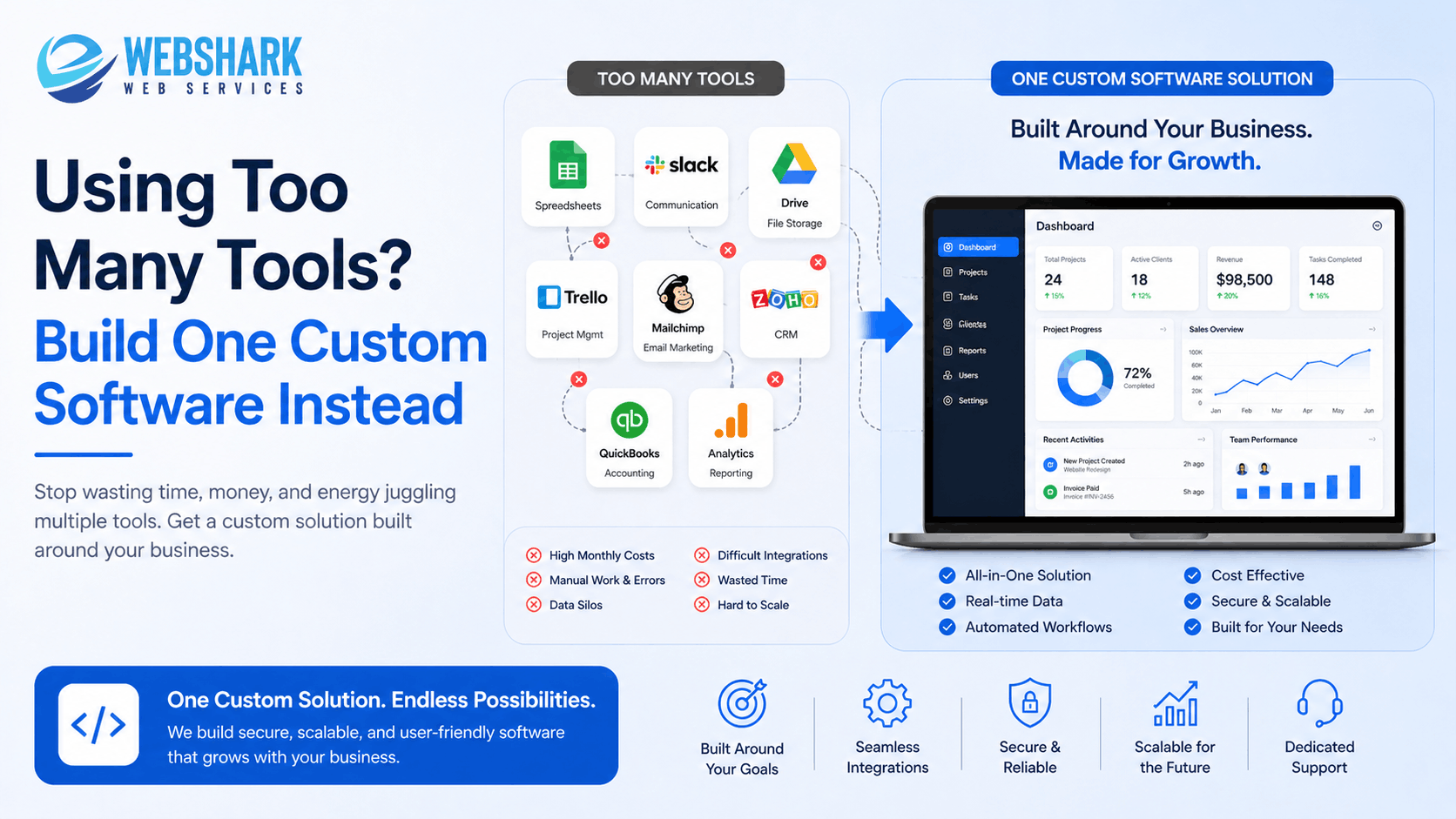

Does your team juggle between 10, 15, or even 20 different software tools just to get through a workday? If you’re nodding your head right now, you’re not alone. The average business uses 110 different SaaS applications, according to recent studies. What started as a quest for efficiency has turned into a productivity nightmare for many organizations.
Here’s the harsh reality: while each tool promises to solve a specific problem, together they create a bigger one. You’re drowning in subscription fees, your data is scattered across platforms that don’t communicate, and your team wastes precious hours switching between apps and re-entering the same information.
It’s time to ask yourself a critical question: What if you could replace your tangled web of tools with one custom software solution built specifically for your business?
The Hidden Cost of Tool Overload
Before we dive into the solution, let’s talk about what all those tools are really costing you—and I’m not just talking about money.
1. Death by a Thousand Subscriptions
Take a moment to calculate your monthly SaaS spending. Most businesses are shocked when they actually add it up:
- Project management: $50-200/month
- CRM software: $75-300/month
- Communication tools: $30-150/month
- Marketing automation: $100-500/month
- Time tracking: $20-100/month
- Document management: $40-150/month
- Analytics tools: $100-400/month
- Customer support software: $60-200/month
That’s potentially $2,000+ per month or $24,000+ annually—and this is a conservative estimate for a small to medium-sized business. Scale this across a larger organization, and you’re looking at six-figure annual costs.
2. The Integration Nightmare
“But they all integrate!” Sure, some do. But have you ever tried setting up a Zapier workflow that connects five different apps? It’s like trying to translate a conversation through four different languages—something always gets lost in translation.
Data doesn’t flow seamlessly. You’re constantly dealing with:
- Sync delays and failures
- Duplicate entries
- Missing information
- API limitations
- Version incompatibilities
Your team ends up spending hours troubleshooting integrations instead of doing actual work.
3. Context Switching Kills Productivity
Research shows that it takes an average of 23 minutes to refocus after a distraction. Now imagine your team switching between 10-15 different tools throughout the day. Each switch is a cognitive burden that fragments attention and depletes mental energy.
Your marketing manager might start their morning checking email, then jump to the CRM, switch to the social media scheduler, review analytics in another tool, update the project management board, and respond to customer queries in yet another platform—all before lunch. This constant context switching can reduce productivity by up to 40%.
4. Training and Onboarding Chaos
Every new hire faces a daunting first week: here are your 15 login credentials, 15 different interfaces to learn, and 15 sets of quirks and workflows to memorize. What should be a smooth onboarding process becomes weeks of confusion and inefficiency.
Even experienced employees struggle when tools update their interfaces or when the company switches to a new platform. The learning curve never ends.
The Custom Software Alternative: One Tool to Rule Them All
Imagine this instead: one centralized platform that does everything your business needs. One login. One interface. One place where all your data lives and breathes together.
This isn’t a pipe dream—it’s what custom software development makes possible.
What Makes Custom Software Different?
Unlike off-the-shelf SaaS products designed for mass appeal, custom software is built around your specific workflows, processes, and needs. Whether you need enterprise software development for large-scale operations or a focused solution for specific challenges, here’s what that means:
Perfect Fit, Zero Bloat
You get exactly the features you need—nothing more, nothing less. No paying for fancy features you’ll never use. No adapting your processes to fit the software’s limitations.
True Integration
When everything exists within one system, there’s no need for middleware, APIs, or integration tools. Your customer data, project timelines, financial records, and communication history all speak the same language because they’re part of the same ecosystem.
Scalability on Your Terms
As your business grows and evolves, your software grows with it. Need a new module? Add it. Want to modify a workflow? Change it. Your software adapts to you, not the other way around. With modern native cloud development approaches, scaling becomes seamless and cost-effective.
Data Ownership and Security
Your data isn’t scattered across 15 different servers owned by 15 different companies with 15 different security policies. Everything is under one roof, with security protocols you control.
When Does Custom Software Make Sense?
Let’s be practical—custom software isn’t the right solution for every business. Here are the clear indicators that it’s time to consider consolidation:
You’re the Right Candidate If:
- You’re using 8+ different tools that handle related functions
- Your monthly SaaS expenses exceed $1,500
- Your team regularly complains about switching between platforms
- Data inconsistency creates problems across departments
- You have unique workflows that off-the-shelf software can’t accommodate
- Integration failures cause regular disruptions
- Onboarding new employees takes weeks due to tool complexity
Real-World Success Story
Consider a mid-sized digital marketing agency that came to Webshark Web Services drowning in tools. They were using:
- Three different project management systems (different teams preferred different tools)
- Two CRM platforms (that couldn’t communicate with each other)
- Separate time tracking, invoicing, and reporting tools
- Multiple communication platforms
- Various file sharing services
Their monthly tool expenses: $3,200. Their pain points: data silos, project delays from miscommunication, and client frustration from inconsistent reporting.
Webshark developed a unified platform that combined project management, custom CRM development, time tracking, invoicing, team communication, and client portals into one seamless system. We also provided ERP integration services to connect with their existing financial systems.
The results after 6 months:
- Monthly software costs reduced to $400 (hosting and maintenance)
- Project completion time improved by 35%
- Client satisfaction scores increased by 48%
- Employee onboarding reduced from 3 weeks to 5 days
- ROI achieved in just 14 months
The ROI Equation: Breaking Down the Numbers
Let’s talk about the investment because that’s usually the first concern. Yes, custom software requires upfront investment, but the math often works strongly in your favor.
Traditional SaaS Model:
- Year 1-5 ongoing costs: $24,000/year × 5 = $120,000
- No equity or asset value
- Costs increase with scaling
- Trapped in vendor ecosystems
Custom Software Model:
- Initial development: $40,000-$80,000 (varies by complexity)
- Annual maintenance: $4,000-$8,000
- 5-year total: $60,000-$120,000
- Own the asset
- Costs decrease as percentage of revenue over time
- Complete control and flexibility
Even at the higher end, you’re breaking even—but that’s not where the real value lies. The productivity gains, reduced errors, improved customer experience, and competitive advantage of having software perfectly tailored to your needs? That’s where custom software pays for itself many times over.
Choosing the Right Development Approach
Not all custom software is built the same way. Depending on your timeline, budget, and requirements, different approaches might suit your needs:
Traditional Custom Development
Full software development from scratch gives you complete control and unlimited customization. Best for complex, unique requirements.
Low-Code/No-Code Solutions
For faster deployment and easier maintenance, low-code/no-code development can deliver results in weeks rather than months while still offering significant customization.
SaaS Platform Development
If you’re looking to build a scalable solution that can serve multiple clients or departments, SaaS development provides a multi-tenant architecture with centralized management.
API-First Architecture
Need to connect with existing systems? API development ensures your custom solution integrates seamlessly with other platforms while maintaining data flow and consistency.
Cloud-Native Solutions
Modern businesses need modern infrastructure. PaaS development and XaaS development approaches provide flexibility, scalability, and cost-efficiency that traditional hosting can’t match.
The right approach depends on your specific situation, and Webshark’s experts can guide you toward the optimal solution.
Making the Transition: What to Expect
Switching from multiple tools to custom software isn’t an overnight process, but with the right partner, it’s smoother than you might think.
The Webshark Approach
Phase 1: Discovery and Audit (2-3 weeks)
We analyze your current tools, workflows, pain points, and objectives. We identify what’s working, what’s not, and what opportunities exist for improvement.
Phase 2: Strategic Planning (1-2 weeks)
Together, we design a solution that consolidates your tools while enhancing functionality. We prioritize features based on impact and create a realistic timeline.
Phase 3: Development (8-16 weeks)
We build your custom platform using agile methodology, providing regular demos and incorporating your feedback throughout the process.
Phase 4: Migration and Training (2-4 weeks)
We handle the complex work of migrating your data and train your team on the new system. We ensure a smooth transition with minimal disruption.
Phase 5: Ongoing Support
We provide continuous maintenance, updates, and enhancements as your business evolves.
Your Next Step
If you’re tired of the tool chaos and ready to explore what custom software could do for your business, Webshark Web Services is here to help.
We specialize in building elegant, powerful software solutions that consolidate complexity into simplicity. Our team has helped dozens of businesses escape the SaaS subscription trap and take control of their technology stack.
Start with a free tool audit. We’ll analyze your current software ecosystem, identify consolidation opportunities, and provide a clear roadmap with projected ROI—no obligation, no pressure.
Because at the end of the day, tools should work for you, not the other way around.