
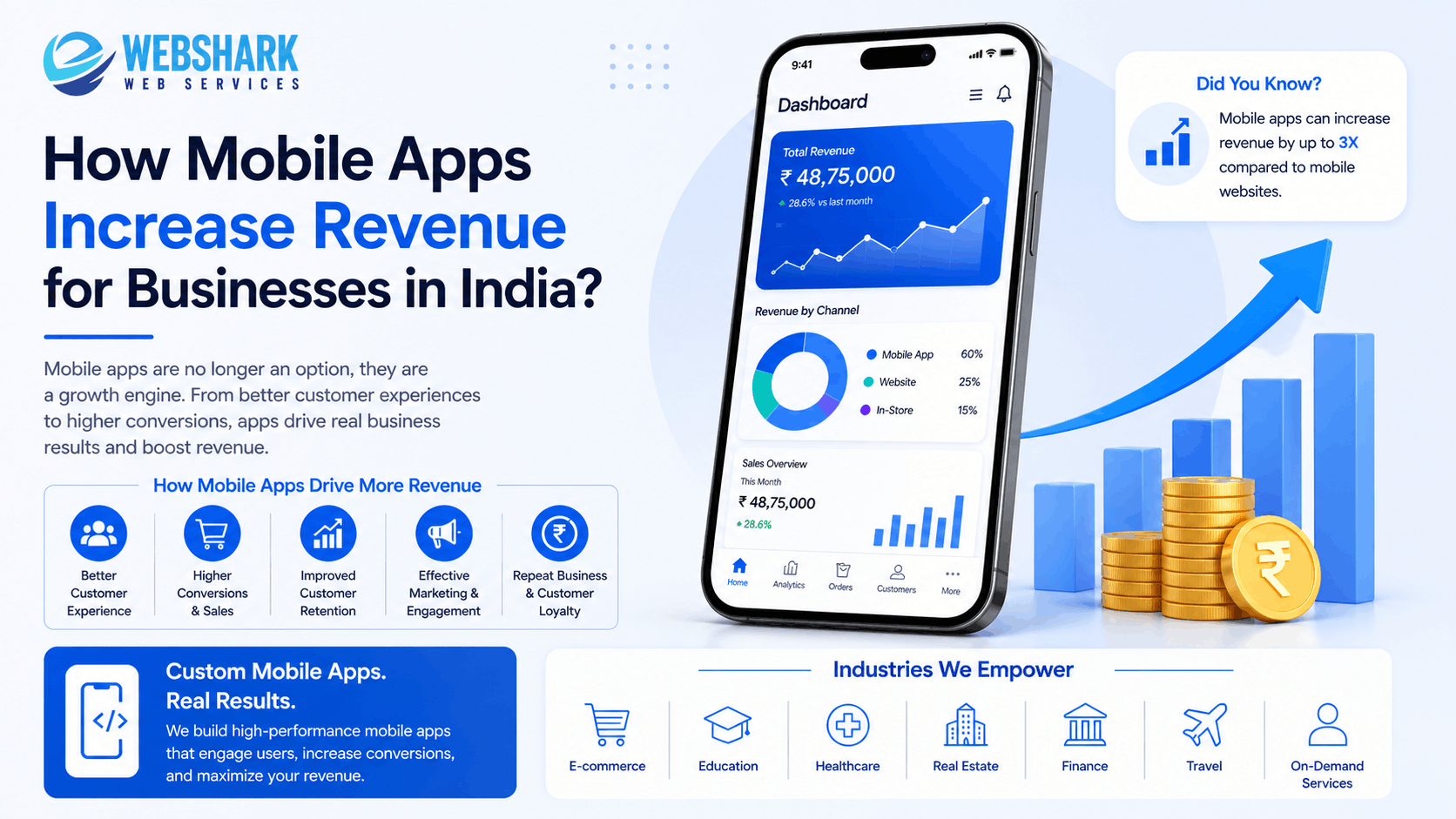

India has over 820 million smartphone users—the second-largest mobile market in the world. Yet, a staggering 68% of Indian businesses still don’t have a mobile app. For those who do? They’re experiencing revenue growth that leaves their competitors wondering what happened.
The numbers tell a compelling story: businesses with mobile apps see an average revenue increase of 35-85% within the first year of launch. Some industries—like retail, food delivery, and financial services—report even higher gains, with revenue jumps exceeding 200% in certain cases.
But here’s what’s interesting: it’s not just about having an app. It’s about having the right app with the right features that directly drive revenue. At Webshark Web Services, we’ve helped Indian businesses across sectors transform their revenue trajectories through strategic software development.
This article breaks down exactly how mobile apps become revenue-generating machines for Indian businesses—with real numbers, proven strategies, and actionable insights.
The Indian Mobile Commerce Revolution
Before diving into revenue strategies, let’s understand the landscape:
- Mobile commerce in India: Expected to reach $165 billion by 2026
- Mobile payment transactions: Growing 76% year-over-year
- Average time spent on mobile apps: 4.9 hours daily per user
- App vs. Mobile web conversions: Apps convert 3x better than mobile websites
- Customer retention: App users are 5x more likely to remain customers
The shift is clear: Indian consumers prefer apps over websites, and they’re willing to spend more through apps they trust.
7 Proven Ways Mobile Apps Drive Revenue Growth
1. Direct Sales Channel with Higher Conversions
Mobile apps outperform mobile websites in every conversion metric that matters:
The Numbers:
- App conversion rates: 2-5% average
- Mobile web conversion rates: 0.5-1.5% average
- Average order value in apps: 30-40% higher than mobile web
- Checkout abandonment: 20-30% lower in apps
Why Apps Convert Better:
Faster, Smoother Experience
Apps load 2-5 times faster than mobile websites. Every second of delay costs you 7% in conversions. Indian users, often on 4G connections, expect instant responses.
One-Tap Checkout
Saved payment methods, addresses, and preferences mean customers complete purchases in seconds. UPI integration in apps makes payment frictionless—critical in India’s digital payment ecosystem.
Offline Capability
Apps work even with poor connectivity. Users can browse, add to cart, and complete purchases when connection resumes. In India, where network reliability varies, this is game-changing.
Personalized Shopping
Apps remember preferences, show relevant products, and create a customized experience that drives repeat purchases.
Real Example:
A Webshark client in Mumbai’s fashion retail sector saw their conversion rate jump from 1.2% (mobile web) to 4.7% (app) within 3 months of launch. With the same traffic volume, revenue increased by 291%.
2. Push Notifications: The Revenue Multiplier
Push notifications are permission-based marketing gold. When done right, they drive immediate revenue:
Performance Metrics:
- Open rate: 90% for push notifications vs. 20-25% for emails
- Response rate: 7x higher than email marketing
- Revenue per push campaign: ₹45,000-₹2.5 lakhs average for SMBs
- Optimal frequency: 3-5 notifications per week (more = uninstalls)
High-Converting Push Strategies:
Abandoned Cart Recovery
“You left something behind! Complete your order and get 10% off.” These notifications recover 15-25% of abandoned carts on average.
Flash Sales and Limited-Time Offers
Create urgency. “2 hours only: 40% off electronics!” Time-bound offers generate immediate action.
Personalized Recommendations
“Based on your recent purchase, you might like these…” Recommendation pushes see 3x higher click-through rates.
Location-Based Triggers
“You’re near our store! Show this notification for 20% off today.” Geo-fencing drives foot traffic and in-store sales.
Stock Alerts
“Your wishlist item is back in stock!” These convert at 30-40% because the customer already expressed interest.
Real Numbers:
A Webshark client in the home decor space generates ₹12-18 lakhs monthly revenue directly attributable to push notifications—representing 23% of their total app revenue.
3. Customer Loyalty Programs That Actually Work
Building loyalty in apps is 10x more effective than traditional programs:
Why App-Based Loyalty Works:
Always Accessible
No physical cards to forget. Loyalty points, tier status, and rewards are always in their pocket.
Gamification
Point systems, achievement badges, streak rewards, and tier progressions keep users engaged and spending more.
Instant Gratification
Redeem points immediately, not weeks later. See rewards unlock in real-time.
Personalized Rewards
AI-powered custom CRM development enables rewards based on individual behavior and preferences.
Revenue Impact:
- Repeat purchase rate: Increases 40-60% with loyalty programs
- Average order value: Loyalty members spend 30% more per transaction
- Customer lifetime value: 3-5x higher for loyalty program members
- Referral rate: Loyalty members refer 2.5x more new customers
Example Structure:
A restaurant chain client implemented a points-based system: ₹100 spent = 10 points, 100 points = ₹100 off. Result? Repeat customers increased from 28% to 67% in 8 months, adding ₹2.4 crores in annual revenue.
4. Data-Driven Personalization = Higher Spending
Apps collect valuable behavioral data that directly translates to revenue:
What Apps Track:
- Browse patterns and product interests
- Time spent on different categories
- Search queries and filters used
- Abandoned cart items
- Purchase history and frequency
- Price sensitivity and preferred discount levels
How This Data Drives Revenue:
Dynamic Pricing
Show different prices or offers based on user’s demonstrated price sensitivity and purchase likelihood.
Product Recommendations
AI algorithms suggest products with 65-80% higher conversion than random suggestions.
Timing Optimization
Send offers when users are most likely to purchase based on their app usage patterns.
Inventory Matching
Prioritize showing products you need to move to users most likely to buy them.
Revenue Lift:
Businesses using advanced personalization through enterprise software development see 15-30% revenue increases from the same customer base.
5. Reduced Customer Acquisition Costs
While building an app requires upfront investment, the long-term CAC (Customer Acquisition Cost) reduction is substantial:
Traditional Digital Marketing CAC:
- Google Ads: ₹800-₹2,500 per customer
- Facebook Ads: ₹500-₹1,800 per customer
- Instagram Ads: ₹600-₹2,200 per customer
App-Driven Customer Acquisition:
- Organic app store discovery: ₹0 per customer
- User referrals (incentivized): ₹150-₹400 per customer
- Push notification campaigns: ₹50-₹200 per reactivated customer
- In-app sharing features: ₹0-₹100 per customer
The Multiplier Effect:
Once you have 10,000 app users, your push notification to all of them costs virtually nothing beyond the platform fee—maybe ₹2,000-₹5,000 total. To reach 10,000 people via Facebook ads would cost ₹50,000-₹2,00,000.
Real Impact:
A Webshark client in educational services reduced their CAC from ₹1,850 to ₹420 over 18 months by shifting marketing focus to app-based referral programs and push campaigns.
6. Premium Features and In-App Purchases
Monetize directly through the app itself:
Freemium Model
Offer basic features free, charge for premium:
- Subscription tiers (₹99/month basic, ₹299/month premium)
- Feature unlocks (advanced filters, priority support)
- Content access (premium articles, videos, courses)
Transaction Fees
If you’re a platform connecting buyers and sellers:
- Commission on transactions (5-20% typical)
- Featured listings or premium placements
- Advertising revenue from third parties
Digital Products
Sell digital goods with 100% margin:
- E-books, courses, templates
- Virtual consultations
- Premium content subscriptions
Add-On Services
Upsell complementary services:
- Extended warranties
- Installation services
- Premium customer support
- Express delivery
Revenue Potential:
A Webshark client running a fitness coaching app generates ₹8.5 lakhs monthly from in-app subscriptions (₹499/month), representing 42% of total revenue—pure profit margin compared to physical product sales.
7. Improved Operational Efficiency = Hidden Revenue
Revenue isn’t just about selling more—it’s also about keeping more of what you earn:
Cost Reductions Through Apps:
Lower Support Costs
Self-service features, FAQs, chatbots, and order tracking reduce support tickets by 40-60%. If you’re currently spending ₹3 lakhs monthly on support staff, that’s ₹1.2-1.8 lakhs saved monthly.
Reduced Processing Errors
Automated order processing eliminates manual errors that cost money (wrong shipments, incorrect billing, duplicate orders). Typical savings: 5-8% of order value.
Inventory Optimization
Real-time inventory tracking through integrated ERP integration services reduces overstocking and stockouts. Average inventory cost reduction: 15-25%.
Marketing Efficiency
Targeted in-app campaigns cost 70-80% less than broad digital advertising while delivering better results.
Faster Transactions
Each transaction processed through app takes 60-80% less time than phone or in-person. Time saved = capacity for more transactions.
Combined Impact:
These operational efficiencies typically save businesses 20-35% of operating costs, directly improving profit margins and freeing up capital for growth.
Industry-Specific Revenue Impact
Different sectors see different revenue multipliers:
E-Commerce & Retail: 50-120% revenue increase
Food & Beverage: 70-180% revenue increase
Healthcare & Wellness: 40-90% revenue increase
Education & Training: 60-150% revenue increase
Financial Services: 35-80% revenue increase
Real Estate: 45-95% revenue increase
Professional Services: 30-70% revenue increase
Real Success Stories from Webshark Clients
Case Study: Bangalore-Based Grocery Chain
Before App:
- 12 stores, ₹18 crore annual revenue
- 85% in-store, 15% phone orders
- Average order value: ₹847
- Customer retention: 34%
After App (Built by Webshark):
- 15 stores, ₹31 crore annual revenue (72% increase)
- 42% in-store, 58% app orders
- Average order value: ₹1,180 (39% higher)
- Customer retention: 71%
- New revenue streams: Subscription service (₹8.4 lakhs/month)
App Features Driving Revenue:
- One-tap reordering of previous purchases
- Scheduled delivery slots
- Loyalty points (1 point per ₹10 spent)
- Push notifications for deals
- Express delivery premium option
Case Study: Mumbai Fashion Boutique Chain
Before App:
- 6 stores, ₹4.2 crore annual revenue
- Website: 3,500 monthly visitors, 1.1% conversion
- No customer data or retention strategy
After App (Webshark SaaS development):
- 8 stores, ₹9.8 crore annual revenue (133% increase)
- App: 45,000 downloads, 4.8% conversion rate
- Customer lifetime value increased 340%
Revenue Drivers:
- Virtual try-on using AR
- Personalized style recommendations
- VIP early access to new collections
- In-app exclusive discounts
- Personal shopper chat feature
The ROI Timeline: What to Expect
Months 1-3: Investment phase
- App development and launch
- Initial marketing and user acquisition
- Learning and optimization
- Revenue impact: 0-15% increase
Months 4-6: Growth phase
- User base expanding
- Feature optimization based on data
- Marketing efficiency improving
- Revenue impact: 15-40% increase
Months 7-12: Scale phase
- Loyal user base established
- Referral momentum building
- Operational efficiencies realized
- Revenue impact: 40-85% increase
Year 2+: Maturity phase
- Market leadership established
- Brand loyalty solidified
- Continuous improvement cycles
- Revenue impact: 85-200%+ increase
Investment Recovery: Most businesses recover their app development investment within 8-14 months, then enjoy pure ROI gains.
Getting Started: Your Revenue Growth Roadmap
Step 1: Define Revenue Goals
Be specific:
- Increase average order value by X%
- Improve conversion rate from X% to Y%
- Reduce CAC by ₹X
- Achieve X% repeat purchase rate
- Generate ₹X from in-app purchases
Step 2: Choose the Right Features
Not every feature drives revenue equally. Prioritize:
- Must-Have: Payment integration, push notifications, user accounts
- High-Impact: Loyalty programs, personalization, one-tap reordering
- Nice-to-Have: AR features, social sharing, gamification
Step 3: Select the Right Development Partner
Look for:
- Experience in your industry
- Understanding of Indian market nuances
- Native cloud development capabilities for scalability
- Clear pricing and timeline
- Post-launch support and optimization
Step 4: Launch and Optimize
- Soft launch to test user group
- Gather feedback and refine
- Full launch with marketing push
- Continuous A/B testing and optimization
- Monthly revenue analysis and strategy adjustment
Why Webshark for Revenue-Driving Mobile Apps?
At Webshark Web Services, we don’t just build apps—we build revenue engines:
Revenue-First Approach
Every feature we recommend is tied to a revenue goal. We think like business owners, not just developers.
India-Optimized Solutions
We understand Indian consumer behavior, payment preferences, and market dynamics. Our apps work perfectly on budget devices with inconsistent connectivity.
Proven Track Record
Our clients see an average revenue increase of 67% within 12 months. We have case studies and metrics to back it up.
Complete Service Stack
From API development to custom CRM integration, we provide everything needed for revenue growth.
Transparent Pricing
No hidden costs. Clear timelines. Fixed-price or time-and-material options based on your preference.
Ongoing Optimization
We don’t disappear after launch. We partner with you to continuously improve conversion rates and revenue metrics.
Your Next Step: Free Revenue Potential Analysis
Want to know exactly how much revenue a mobile app could add to your business?
We offer a complimentary revenue potential analysis where we:
- Analyze your current sales channels and conversion rates
- Benchmark against your industry standards
- Project realistic revenue increases based on our client data
- Recommend specific features for maximum ROI
- Provide timeline and investment breakdown
No sales pressure. No generic proposals. Just data-driven insights specific to your business.