

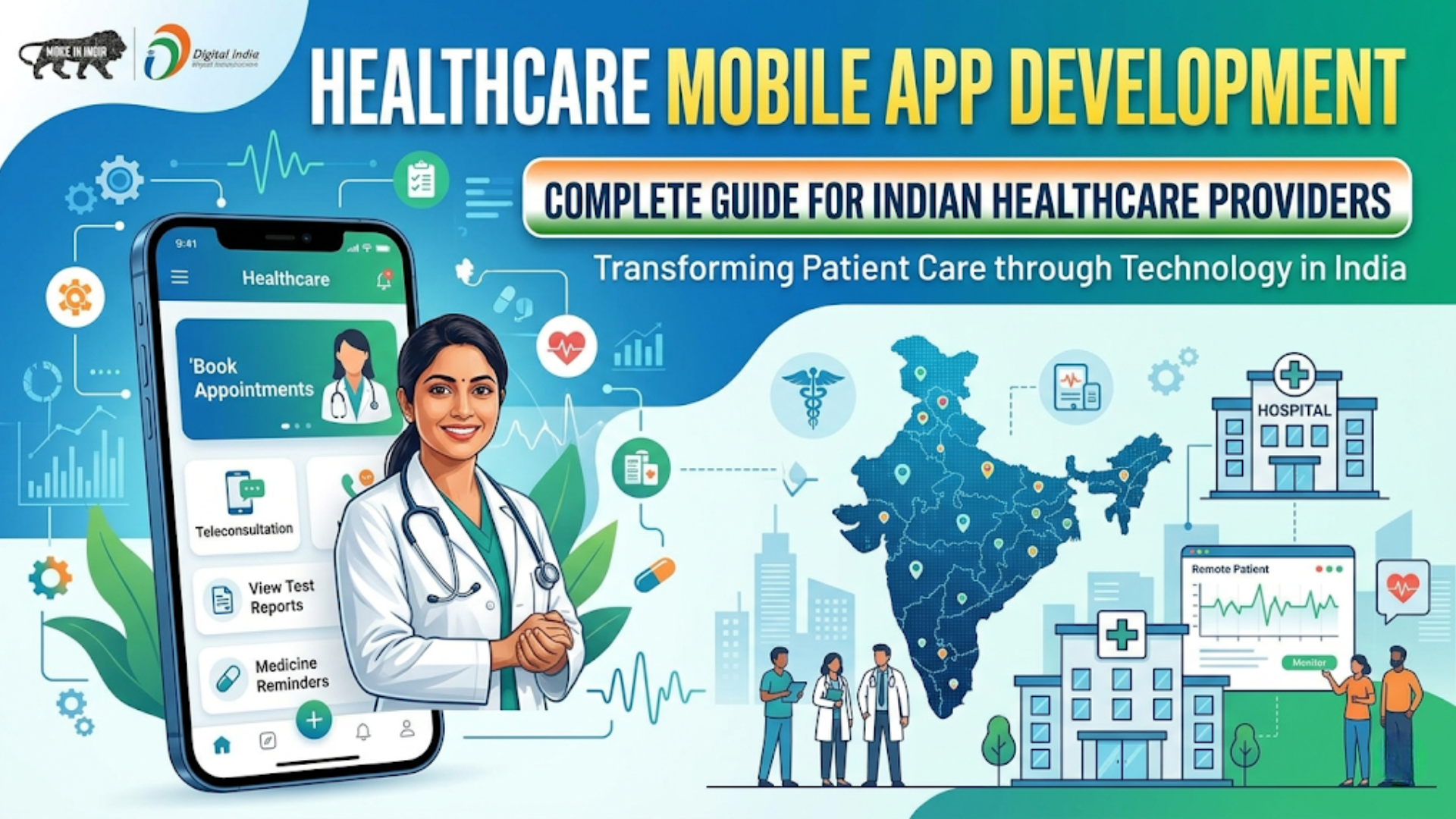

The Indian healthcare sector is going through a digital revolution, and if you’re not on board yet, you’re already behind. After working with Webshark Web Services and consulting for numerous healthcare startups and hospitals over the past decade, I’ve seen firsthand how mobile app development is transforming patient care in India.
Let me share what actually works and what’s just hype.
Why Healthcare Apps Matter More Than Ever in India
Here’s a reality check: India has only 1 doctor for every 1,445 people (WHO recommends 1:1,000). Patients in tier 2 and tier 3 cities often travel 50-100 km for basic consultations. Healthcare apps aren’t just convenient—they’re literally bridging the gap between healthcare access and availability.
The pandemic accelerated what would have taken a decade otherwise. Telemedicine consultations jumped from virtually zero to over 120 million in 2020-2021. That’s not going back down.
Types of Healthcare Mobile Apps
Not all healthcare apps are created equal. Here’s what’s actually being built and used:
1. Telemedicine & Consultation Apps
Video consultations, chat-based diagnosis, e-prescriptions. Think Practo, 1mg Doctor, or Tata Health.
Key features needed:
- Real-time video calling (needs to work on 3G/4G)
- Secure messaging with encryption
- Digital prescription generation
- Payment gateway integration
- Doctor availability scheduling
Development cost: ₹8-15 lakhs for basic version
2. Appointment Booking & Queue Management
Hospital visit scheduling, token systems, OPD management.
Why it matters: Average waiting time in Indian hospitals is 2-4 hours. A good booking system cuts this by 60%.
Development cost: ₹4-8 lakhs
3. Patient Health Record (PHR) Apps
Digital storage of medical records, lab reports, prescriptions. This is getting huge with government’s ABDM (Ayushman Bharat Digital Mission) push.
Critical requirement: Must integrate with ABDM standards and support Health ID creation.
Development cost: ₹6-12 lakhs
4. Medicine Delivery & Pharmacy Apps
Online medicine ordering, pill reminders, refill tracking.
Regulatory hurdle: Need drug license compliance for each state you operate in.
Development cost: ₹10-18 lakhs
5. Fitness & Wellness Tracking
Step counters, calorie trackers, meditation guides. Less regulated but highly competitive market.
Development cost: ₹5-10 lakhs
The Compliance Nightmare (And How to Navigate It)
Here’s what nobody tells you upfront: healthcare apps in India face multiple regulatory layers. Ignore these, and you’re setting yourself up for legal trouble.
ABDM (Ayushman Bharat Digital Mission) Compliance
If you’re building anything related to health records, you MUST integrate with ABDM. This includes:
- Health ID (ABHA ID) creation and linking
- Health facility registry integration
- Healthcare professionals registry
- Health locker for storing records
The good news? Government provides APIs. The bad news? Documentation is scattered and implementation is tricky.
Data Protection & Privacy
While India’s Personal Data Protection Bill is still pending, you need to follow:
- Medical records must be encrypted at rest and in transit
- Patient consent management (explicit opt-ins)
- Data retention policies
- Right to deletion/portability
Pro tip: Build for GDPR compliance standards even though it’s European. When India’s law passes, you’ll be ahead of the curve.
Telemedicine Practice Guidelines
For any app offering doctor consultations:
- First consultation cannot be purely online (though this is loosely enforced)
- Prescriptions must follow standard format
- Controlled substances cannot be prescribed online
- Must maintain 3-year record of consultations
Drug & Cosmetics Act Compliance
For pharmacy apps:
- Need drug licenses for each state
- Cannot sell Schedule X drugs (narcotics) online
- Age verification for certain medicines
- Prescription verification before dispensing
I’ve seen startups spend ₹3-5 lakhs on legal compliance alone. Budget for it.
Platform Choice: iOS vs Android for Healthcare Apps
In healthcare, this decision matters more than usual.
Go Android-First If:
- Targeting tier 2/3 cities and rural areas
- Building for government schemes or public health
- Budget is tight
- Need wider reach quickly
Android app development gives you 95%+ market coverage in India’s healthcare segment.
Go iOS-First If:
- Targeting premium hospitals and corporate wellness
- Building for doctors (they disproportionately use iPhones)
- Focusing on metro cities
- Have specific iOS features to leverage (HealthKit integration)
Go Cross-Platform If:
- Need both but have limited budget
- Timeline is aggressive
- Features are standard (no complex device integrations)
Cross-platform app development using Flutter or React Native can save 30-40% development cost and time.
My recommendation: Start with Android for patients, iOS for doctors. Then expand.
Essential Features for Healthcare Apps
Based on analyzing successful healthcare apps in India:
Must-Have Features:
- Multi-language support – Hindi, regional languages mandatory
- Offline mode – Work without internet for basic features
- Low bandwidth optimization – Many users still on 3G
- Emergency contact quick dial – One-tap ambulance/emergency
- Reminders & notifications – Medicine, appointments, vitals tracking
- Secure authentication – OTP, biometric, two-factor
- Payment integration – UPI, cards, wallets, insurance
Advanced Features Worth Adding:
- AI-based symptom checker – Reduces unnecessary consultations
- Voice commands – Critical for elderly users
- Prescription OCR – Scan and digitize paper prescriptions
- Health vitals tracking – Integration with wearables, BP monitors
- Insurance claim integration – Direct cashless claim filing
- Second opinion feature – Connect with multiple specialists
What Healthcare App Development Actually Costs
Let’s break down realistic numbers for India in 2024-2025:
Basic Telemedicine App (doctor discovery, booking, video call): ₹8-15 lakhs
- 3-4 months development
- Single platform (Android or iOS)
- Standard features
Comprehensive Patient App (records, consultation, medicine, tracking): ₹15-25 lakhs
- 5-6 months development
- Both platforms
- ABDM integration included
Hospital Management System (patient app + doctor app + admin panel): ₹25-40 lakhs
- 6-9 months development
- Full ecosystem with backend
- Custom workflows
Enterprise Healthcare Platform (multi-location hospitals, insurance integration): ₹40 lakhs+
- 9-12+ months
- Complex integrations
- Dedicated support team
Don’t forget ongoing costs:
- Server hosting: ₹15,000-50,000/month (depends on users)
- ABDM integration maintenance: ₹10,000-25,000/month
- Compliance updates: ₹50,000-1 lakh annually
- Security audits: ₹1-2 lakhs annually (non-negotiable for healthcare)
Security: Where You Cannot Afford to Cut Corners
Healthcare data breaches are catastrophic. The average cost of a healthcare data breach in India is ₹17.9 crore (IBM Security Report 2023).
Non-Negotiable Security Requirements:
- End-to-End Encryption: All patient data in transit and at rest
- Role-Based Access Control: Not everyone should see everything
- Audit Logs: Track who accessed what data and when
- Regular Security Testing: Penetration testing every 6 months
- Secure APIs: All endpoints must be authenticated and rate-limited
- Backup & Disaster Recovery: 3-2-1 backup rule (3 copies, 2 mediums, 1 offsite)
Budget minimum ₹2-3 lakhs annually for security – this includes SSL certificates, security audits, encryption tools, and compliance checks.
I’ve worked with a clinic that skipped security audits to save ₹80,000. They faced a breach, lost patient trust, and spent ₹25 lakhs in damage control. Don’t be them.
Technology Stack Recommendations
After seeing what works in real-world Indian healthcare apps:
Backend:
- Node.js or Python (Django) – Fast development, good for MVPs
- PostgreSQL or MongoDB – Reliable, HIPAA-compliant
- AWS or Google Cloud – Better than local hosting for healthcare
- Firebase – Good for real-time features, notifications
Frontend:
- React Native or Flutter – If going cross-platform
- Native iOS (Swift) + Native Android (Kotlin) – If budget permits
- Progressive Web App – Consider for basic features
Third-Party Integrations:
- Twilio/Agora – Video calling (Zoom won’t work for healthcare HIPAA needs)
- Razorpay/Cashfree – Healthcare-compliant payment gateways
- AWS S3 – HIPAA-compliant file storage
- SendGrid/AWS SES – Email notifications
- OneSignal – Push notifications
Common Mistakes That Kill Healthcare Apps
I’ve seen these destroy otherwise good apps:
1. Ignoring Doctor Experience
Everyone focuses on patient app. The doctor app is what makes or breaks adoption. Doctors won’t use clunky interfaces.
Solution: Involve practicing doctors in design phase, not just at the end.
2. Over-Engineering Version 1
Trying to build everything in MVP. You don’t need AI diagnosis in version 1.
Solution: Start with appointment booking + video consultation. Add features based on usage data.
3. Underestimating ABDM Integration
Thinking it’s just another API integration. It’s not.
Solution: Allocate 3-4 weeks purely for ABDM integration and testing.
4. Poor Network Handling
Building for 5G when 60% users are on 3G/4G with spotty coverage.
Solution: Offline mode for critical features, aggressive data compression, low-res video options.
5. Ignoring Elderly Users
18% of India’s population is 60+. They need larger fonts, simpler navigation, voice support.
Solution: User test with actual elderly users, not just your team.
Timeline: What to Realistically Expect
Month 1-2: Planning & Compliance
- Regulatory research
- ABDM documentation
- Feature finalization
- Design mockups
Month 3-5: Development
- Core app development
- ABDM integration
- Security implementation
- Doctor/patient module development
Month 6: Testing
- Security testing
- Compliance verification
- User acceptance testing
- Load testing
Month 7-8: Deployment & Support
- App store submissions
- Server setup
- Monitoring tools
- Training materials
Total: 7-8 months for a solid healthcare app. Anyone promising 3-4 months for a comprehensive solution is cutting corners somewhere.
Questions to Ask Your Healthcare App Development Partner
Based on projects that went wrong (and right):
- “Have you built ABDM-integrated apps before?” – This is specialized. Generic mobile app developers struggle here.
- “What’s your approach to healthcare data security?” – They should mention encryption, HIPAA standards, security audits without you asking.
- “Can you handle telemedicine compliance?” – Need to understand Telemedicine Practice Guidelines 2020.
- “How do you manage video consultation quality on poor networks?” – Should have specific technical solutions, not just “we’ll optimize.”
- “What’s your experience with medical APIs and integrations?” – Lab integrations, diagnostic center APIs, insurance APIs—all complex.
- “Do you provide post-launch compliance support?” – Regulations change. Who updates the app?
The Real ROI of Healthcare Apps
Let me share some numbers from actual implementations:
Mid-sized Hospital (150 beds):
- App development cost: ₹18 lakhs
- Reduced no-shows by 40% (saves ₹8-10 lakhs annually)
- Increased patient retention by 25%
- ROI breakeven: 18-24 months
Diagnostic Chain (8 locations):
- App + web platform: ₹25 lakhs
- Online booking increased by 35%
- Customer support calls reduced by 50%
- ROI breakeven: 12-15 months
Telemedicine Startup:
- MVP development: ₹12 lakhs
- Acquired 10,000+ users in 6 months
- Monthly revenue: ₹4-5 lakhs by month 8
- Raised seed funding based on app metrics
The apps that succeed aren’t just well-built—they solve real problems for real users.
Future Trends in Healthcare Apps (2024-2026)
Watch these spaces:
AI-Powered Diagnosis: Symptom checkers getting smarter, especially for common conditions
Wearable Integration: Apple Watch, Fitbit data integration becoming standard
Mental Health Apps: Therapy, counseling, stress management—huge untapped market
Blockchain for Records: Secure, tamper-proof medical records (still early stage)
Voice-First Interfaces: Critical for semi-literate and elderly users
Regional Language AI: Voice consultations in Hindi, Tamil, Telugu, Bengali
The Bottom Line
Healthcare mobile app development isn’t just another app project. It’s about improving healthcare access for millions of Indians who don’t have easy access to quality medical care.
Whether you’re a hospital looking to digitize, a startup disrupting healthcare, or a clinic wanting to serve patients better, the right app can be transformative.
Working with experienced partners like Webshark Web Services who understand both the technical complexity and regulatory landscape makes all the difference. This isn’t a space for experimentation—get it right the first time.
The Indian healthcare app market is expected to reach $10 billion by 2025. The opportunity is massive, but so is the responsibility. Your app will hold sensitive patient data, potentially life-critical information.
Choose your development partner wisely. Build with compliance and security as foundations, not afterthoughts. Focus on solving real problems, not just building features.